
Old Race Tyres: Why You Should Bin Those 19-Year-Old Slicks
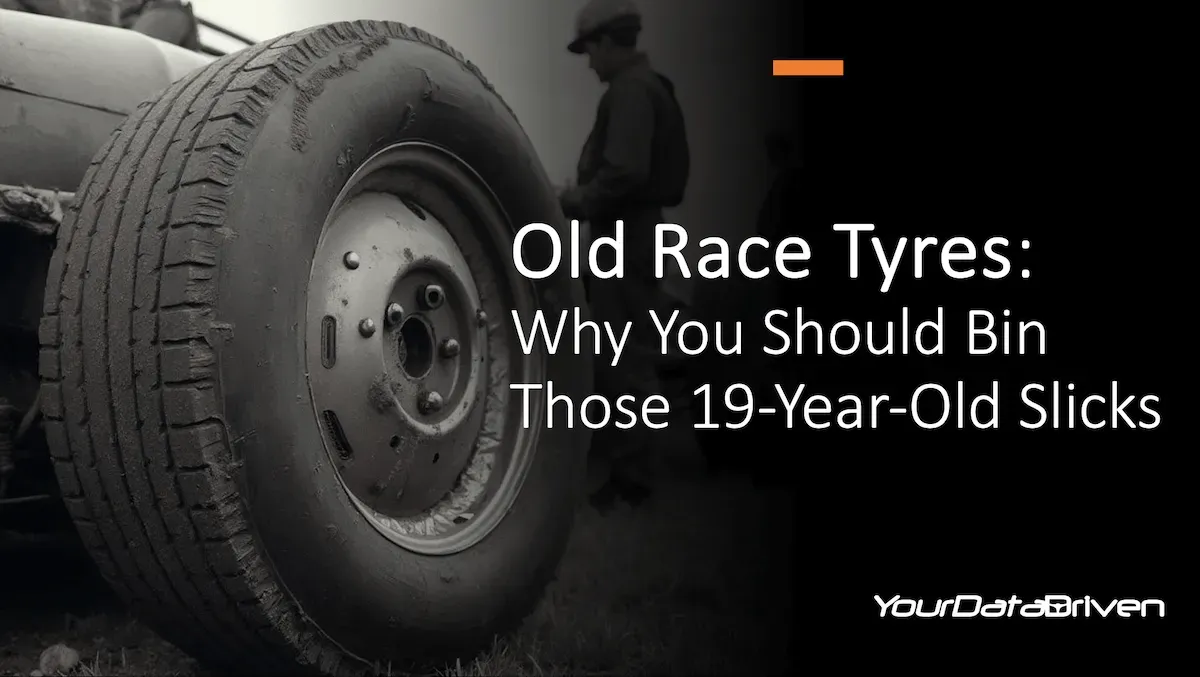
A driver recently told me they’d sent their son out on 19-year-old race tyres. Why? Because they were “faster” than new road tyres.
Let that sink in for a moment. Tyres from 2005.
I’m going to recommend you do not do that.
But also explain why…
If you enjoy this article, be sure to subscribe to my weekly email, “Ahead of the Curve,” to make sure you never miss the latest.
Why Old Race Tyres Feel Deceptively Good
Here’s the thing—those old race tyres might actually give you a quick lap time. The compound was designed for maximum grip, and some of that magic remains.
But there’s something more important happening beneath the surface.
Even in perfect storage, tyres degrade chemically over time.
Here’s what’s happening inside your tyres right now:
-
Oxygen exposure (Oxidation):
Oxygen in the air reacts with the rubber’s polymer structure, leading to oxidative degradation. This weakens the molecular bonds that give the rubber its strength and elasticity. Over time, oxidation causes the tyre to become harder and more brittle, increasing the risk of failure. -
UV radiation:
Even when tyres are stored indoors, UV rays from indirect sunlight or artificial light can break down the chemical bonds in the rubber. This process, known as photodegradation, accelerates surface cracking and weakens the tyre’s ability to flex under load. (Wikipedia: UV Degradation) -
Temperature changes and ozone exposure:
Ozone in the atmosphere is highly reactive and attacks the rubber, leading to ozone cracking—fine cracks that develop on the surface, particularly in areas under tension like the sidewalls. Frequent temperature fluctuations also cause the rubber to expand and contract, further degrading its structure. (Wikipedia: Ozone Cracking) -
Polymer chain degradation:
Tyres are made from long polymer chains that provide flexibility and resilience. Over time, these chains either break down (chain scission) or form unwanted links (cross-linking). Chain scission reduces elasticity, making the tyre brittle, while cross-linking can make the rubber too rigid, leading to unpredictable handling characteristics. (Wikipedia: Polymer Degradation)
Think of it like an old rubber band—it looks fine until the moment it snaps. But with tyres, this isn’t just about losing elasticity.
When these chemical changes compromise the tyre’s structure, old tyres can fail catastrophically under the extreme forces of track driving.
Imagine what 100mph looks like?
I’m all for getting the most from your tyres (see here [link]) but your tyres need to be safe.
3x Quick Checks Before You Hit The Track
-
Check the DOT Code
- Find the 4-digit number on your sidewall.
- First two digits = week, last two = year.
- Over a few years old? Time to retire them.
- Nineteen years old? They belong in a museum.
-
Feel the Rubber
- Run your hand over the sidewalls.
- Look for tiny cracks.
- Check for damage or chunks missing.
-
Trust Your Instincts
- If something feels off, it probably is.
- Don’t let peer pressure override your safety.
- Remember: no lap time is worth that risk.
What You Need to Do
- Donate those vintage tyres to your local kart track – for barriers!
- Invest in proper tyres suited to your level.
- Track their age (like this [link]), not just their wear.
Bottom Line
I do appreciate new tyres are expensive. But…
Your tyres are your only connection to the track.
They determine whether you can brake deep into that corner, carry speed through the apex, and power out with confidence.
Think about what you’re really gambling with here:
- The thousands you’ve invested in track days.
- The hours spent honing your skills.
- Most importantly, your safety and that of others around you.
Sure, those 19-year-old race tyres might help you turn one quick lap.
But when you’re pushing hard through a fast corner, do you really want to be wondering if this is the moment they finally give up?
Make the smart choice—retire those old tyres to the kart track barrier wall where they belong.
Your future self will thank you (and I can rest easy at night!)
If you like this content, be sure to sign up to Ahead of the Curve for more insights like this straight to your inbox!
Whenever you're ready, here are 2 ways I can help you:
Motorsport Skool — The paddock in your pocket. Nearly every course I've ever done, plus unlimited FREE Tech Q&A from our friendly community.
Master Your Tyres course — Go beyond guesswork and become totally self-reliant to tune and drive your tyres. Get more grip, better handling and faster lap times in any conditions.