
2 Reasons Why You Need Rear Brakes on a Racing Car
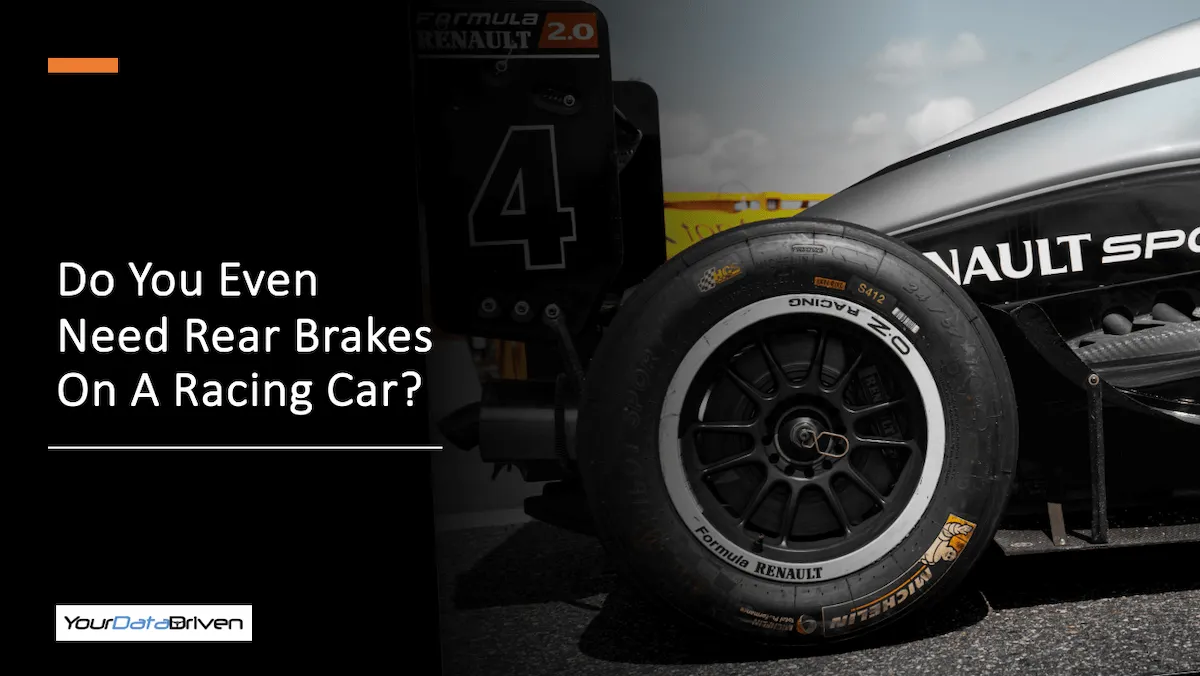
You might hear statements around the paddock about the small role rear brakes play on a racing car. This “Ask Samir” article is a response to a question I had on the subject of whether you need rear brakes on a racing car at all.
Well… do you??
If you enjoy this article, be sure to subscribe to my weekly email, “Ahead of the Curve,” to make sure you never miss the latest.
Rear Brakes on a Racing Car… “don’t do anything”
Hi Samir, do you have any info regarding rear brakes and their effect for on track ?
The general consensus amongst track rats is that the rears don’t do anything it’s all about the fronts. What is the importance/effect of using the rears ?
Andrew
Hey Andrew
Yes, this is a good question and one I’ve heard before.
So my assumption you’re hearing this because their is some logic here.
For example, a lot of load does go to the front wheels under braking.
This can lead to a school of thought that really you’re just carrying the rear brakes around as some kind of unnecessary ballast.
Firstly: What do you think?
Do you think you rear brakes on a racing car are important, or not?
Setup This Experiment
To help you answer this question with more than an opinion, my suggestion would be to set up an experiment and try and find out for yourself.
For example, if you have a data logger, you can monitor peak longitudinal G during a straight-line braking test.
Try running your car with and without rear brakes.
Plus, if you have the time and possibility, throw in some middle-ground tests with different brake bias splits—more or less to the front.
Unless your rear tyres are coming off the ground when you brake, my bet is you’ll see better braking—indicated by a higher peak longitudinal G—with the rear brakes, than without.
So I’m a fan of rear brakes on a racing car personally.
Why Better Braking Gives You Faster Lap Times
If you can slow the car down faster you’ll be able to brake later and for less time.
This means your average speed over the lap will be higher.
And, when you spend more time at higher speeds, you get a faster lap time.
So saying rear brakes “Don’t do anything” might be an oversimplification for a wide range of situations.
2 Other Benefits of Rear Brakes
Clearly if you’re racing and can brake later, that gives you a track positional advantage over your competitors i.e. better overtaking / defending ability.
Plus, you’re often braking while turning into some corners (especially hairpins.)
In this situation on corner entry, i.e. trail braking, your brakes don’t just slow you down—they help the driver balance the load distribution front to rear.
This balance plays a big role in your driving confidence during braking and turn-in.
Clearly you want more confidence and the brakes help you control the load on the tyres, the balance and your feeling behind the wheel.
Why You Do Need Rear Brakes on a Racing Car
So, from my experience, rear brakes on a racing car are very important.
Simply–you’ll be quicker with them than without.
But as always, I encourage you to get out there, design your own experiment, and see for yourself!
Otherwise, how will you know which “expert” to trust?
Hope this helps you - let me know how it goes!
Samir
Whenever you're ready, here are 2 ways I can help you:
Motorsport Skool — The paddock in your pocket. Nearly every course I've ever done, plus unlimited FREE Tech Q&A from our friendly community.
Master Your Tyres course — Go beyond guesswork and become totally self-reliant to tune and drive your tyres. Get more grip, better handling and faster lap times in any conditions.